Tampilkan postingan dengan label indian. Tampilkan semua postingan

Kamis, 14 Maret 2013

THE 'ALMA FOUR'


Story by Kim Scholer; Photographs by Jeppe Sorensen
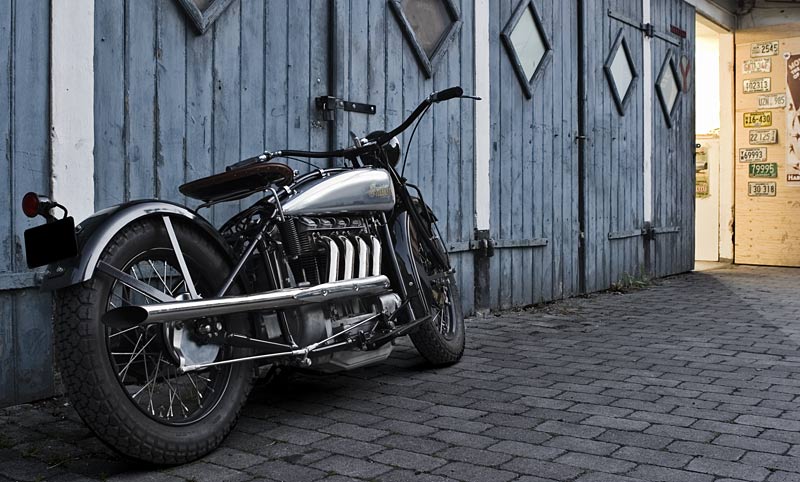
Looking perfectly 'period', the Alma Four is a credit to its creator, Mads Bartholin
The original Indian Four is a design icon, in its time among the most elegant motorcycles to grace the roads. Many attempts have been made to build a 'modern' copy, often using water-cooled car engines, but stylistically they're failures.  Except one, which lives an ocean away from where the Indian, ACE and Henderson Fours were brought to life. Mads Bartholin always wanted an Indian Four, but like most of us, he couldn't afford one. Well-kept Fours go for about US$50-80K, and restoring a bad one will likely cost the same. ACE and Henderson Fours were just as out of reach, and acquiring something slightly less glamorous, like an Indian Scout, was not an option; Mads was firmly in the 'straight four' phase of his life.

An original ca.1928 Indian Four...
Mads had already built one such four; a Danish Nimbus, which he rebuilt with an Indian Four style exhaust system, 16” rear wheel, Harley-Davidson solo seat, and a wide handlebar, and ridden it as far as to North Africa a few times. But much as he liked the Nimbus, he found its 22 bhp engine too weak. Realizing the futility of tuning the stock 750 cc engine, he decided to replace it with a 1000cc straight four from an NSU car. "The NSU engine is air cooled, inexpensive, looks kind of right and there are loads of them around”, claims Mads. The fast, brutal looking Münch Mammoth used just such an NSU Prinz TTS engine, with five times the power of the Nimbus.  In 1997, he made moulds for a new Nimbus flywheel/clutch assembly housing to adapt to the NSU motor, plus a new sump to resemble the angular Nimbus original. A local foundry took care of this for a pittance, and after a few tries it looked right. Mads had suspected the car engine would be a bit on the large side for a Nimbus frame, which turned out to be the case. "It would fit – barely – but there simply wasn't any room for the gearbox or the gas tank", he notes, "so it was back to the drawing board".
First it ran with an Amal carburettor, then with a leaky updraft Tillotson, and finally with this updraft Solex. Gearshift mechanism is from a Nimbus motorcycle, the generator from a VW.
The project was redirected with the goal of creating a 1920s-style American Four. Many evenings and hours were spent at the basement workshop, where Mads would sit, beer in hand, carefully studying various 1:1 scale drawings hung up on the wall. Finally a version reminiscent of a 1928 Indian was decided upon. These first Indian Fours lack the comfort of rear suspension, and the elegance Art Deco fenders of the later Fours, and the upper frame backbone runs across the fuel tanks. The hybrid machine would be a couple of inches longer than its spiritual forefathers, because of the NSU's separate, longitudally mounted gearbox. Maintaining momentum on this project wasn't easy, mainly because Mads, while studying Industrial Design at The Royal Academy of Fine Arts, was perennially broke as a student. "Getting married and having two kids took its toll, too," says Mads, "although thankfully my wife – bless her - has given this project her full support all along the way". On the other hand, with only partial employment, and an uncanny ability to trade favors with people 'in the know', he was able to move forward. Slowly, the sorry remains of an Indian frame, as well as a good number of repro parts, were acquired. Like the frame lugs, both fenders, the solo seat, a complete leaf spring front end and the throttle assembly. Initially a BMW or Moto-Guzzi gearbox was considered, but Mads soon realized that because the NSU's engine rotation would give a lot of reverse gears!  Eventually, a Nimbus gearbox with a new Swedish-built four speed gear cluster arrived at the workshop, along with its shaft drive and rear hub assembly. Somewhere on this journey the motorcycle acquired the name 'The Alma Four, 'Alma' being Latin for 'a particularly beautiful soul' [ah...hence Alma Mahler's legendary magnetism...pd'o].
The Alma Four is of necessity longer than the original Indian 4, to accomodate the longer engine, plus the gearbox and final driveshaft housing
Old brochures and factory photographs usually show the Indian Four from the right hand side, where the elegant exhaust system makes the bike look fast even while parked. In contrast, the left side of Indian Four engines were a mess, cluttered up with the carburettor, the magneto and the dynamo. Paying homage to the original, this is the case with the Alma Four too, even if the distributor hides tidily at the back of the camshaft cover. The updraft Solex carburettor, more commonly found on Ferguson tractors or 1930s Citroën Traction Avants, is mated to a modified NSU intake manifold, and a belt drive spins a Bosch VW generator. In 2002, the engine came together, while a stainless steel four-into-one reverse cone exhaust system was built, mounted on shortened exhaust stacks. At the same time an aqcuaintance rebuilt the frame to match the one-off engine and shaft drive rear end. Many other members of the world-wide Indian motorcycle fraternity had been watching the Alma Four project from the sidelines, helping whenever possible and enthusiasticly cheering Mads on. One of them even flew in from the Fiji Islands to have a look. 
An 'old school' conversion; a Nimbus shaft-drive engine installed in an Indian 4 chassis, some time ago...
Once back from the welder, the frame was placed on the workbench and the engine dropped in. The twin fuel tanks had to be designed and built from scratch, because the ohc NSU engine was much taller than an original engine from Springfield. This was a bit of a problem, as Mads wanted to keep the bike low.  Like the flywheel housing and engine sump, the fuel tanks were cast in aluminum. On the outside they appear stock, but underneath they're shaped to accommodate the large camchain housing, the overhead camshaft, and the valve covers. Plenty of work remained, of course; knurling the fuel caps, welding a bracket for the stock headlamp to resemble a cast item, even grinding the fender bolt heads to half their height were some of the dozens of jobs neccessary to make it all just right. The Indian designers back in the 1920s were damn good and Mads, now officially an industrial designer, was determined do at least as well.
Twin cast-aluminum fuel tanks are hollowed out to accomodate the tall overhead camshaft engine, and the protruding valve covers
In 2006, the Alma Four was finished; "The engine starts first kick, pulls strong, and the bike is steady like any other old 1920s large hardtail, at least up to the 100 mph I've taken it so far", according to Mads. Stopping the quarter-ton behemoth from high speed is a different matter, as the performance of the old Nimbus and Indian brake drums is limited. This NSU engine makes 40 bhp in its stock configuration, while the 1200cc version in the Münch Mammoth made more than 100bhp, and the final 1300cc NSU rally car versions made upwards of 300bhp, with oil-cooled cylinder heads and a turbocharger. "The engine is overengineered and the Alma Four weighs about one-quarter of the car it came from, so reliability is not an issue. Should something undesirable happen to it anyway, it's a fair guess that NSU parts will be cheaper than those for an Indian,” says Mads. "The front end is a repro Scout item, but a Chief version would have looked better, and a real paint job would have been nice too". But these are minor niggles. Unsurprisingly, even vintage bike purists give it a nod of approval, recognizing that no Indian parts were harmed to make this motorcycle. Was it worth spending all those hours building his Four, instead of working the same hours at a regular job, and simply buying an original Indian Four? "Definitely, if not for its value - which probably is on par with a 70-80 year old four anyway - then certainly for being able to ride a unique and comparatively much more reliable motorcycle”. The experience gained by designing and building a motorcycle almost from scratch, is priceless.  It will come in handy for the ohv Super X hillclimber now on his workbench...

Sabtu, 02 Februari 2013

SELLING SPEED: WHAT'S IN A NAME?


Riding the Rocket; well, who's riding what here?
What's in a name? Bonneville. Tiger 100.  SS100. TT Replica. Clubman. Sport. Super Sport. Sportster. Rapid. Rapide. Vitesse. Superswift. Sprint. Speed Twin. Quick. Quickly. Gold Star. Shooting Star. Comet. Meteor. Rocket. Super Rocket. Atlas. Bullet. Jet. Lightning. Black Lightning. Cyclone. Hurricane. Manx. Manxman. Manx Grand Prix. Daytona. Brooklands. Silverstone. LeMans. Ulster. Thruxton. Bol d’Or. Montjuich. Arrow. Blue Arrow. Golden Arrow. F1. F3. Mach 3. Falcon. Hawk. Nighthawk. Super Hawk. Thunderbird. Flying Squirrel. Capriolo. Greyhound. Tiger. Cheetah. Panther. Lion. Crocodile. Red Hunter. Dominator. Commando.

It was Adam’s first job before the Fall -naming the animals- and he set a precedent, using distinct words for each beast, and not a numbering system.  Without the pressure of God looking over their shoulders, motorcycle designers have often failed at Adam’s task, relying on a factory code to identify their work, and we are left with a century of Model 4s, TA3s, CB200s, and other, utterly forgettable ‘names’.  Granted, the TR6 and GSXR earned their fame with a series of numbers and letters, which proves even nonsense syllables can gain the status of a proper name, just as with mantras used for meditation, which are sometimes intentionally meaningless -  its their repetition which counts…and advertisers feel the same way.  Just keep repeating the sound, until you buy one.
Well, you can't just call it the 'Really Fast'...better to Frenchify the name...'Rapide'!
Motorcycle manufacturers figured out early that a memorable name carried a punch, and if a good name was matched by a good product, you’d scored a hit.  This insured the health of the company, and continued employment of the designer giving names, no small matter in the lethal business of selling bikes.  Automobile companies have whole departments conducting tests in rooms with one-way mirrors, measuring reactions of citizens to car names (they didn’t ask my opinion of Impreza, Aspire, or Celebrity…), but motorcycle companies rarely have that kind of budget, for testing or even advertising on a mass scale.  Barring the Japanese boom years of the 1960s/70s, the general public has been spared interrupting their favorite TV soap opera with images of bikers having good, clean, dangerous fun.
The Velocette 'Thruxton'...well named, a strange mashup of 'thrust' and 'sex' and 'ton'...which is perfect.  This is my green Thruxton, nicknamed 'Courgette', which I've owned for nearly 25 years, and was my sole transport at one point...
Not just a Number: Here’s a parable on the value of a good name over a number. Valentine Page, Triumph’s head designer in the early 1930s, built a very well-engineered vertical twin Triumph 650cc, but you’ve never heard of it, because while beautifully made, he lacked the imagination to give it a name, opting instead for a designation; the ‘Model 6/1’.  Plus, it was ugly.  And Triumph nearly went bankrupt. Two years later (1936), an upstart megalomaniac named Edward Turner was hired away from Ariel to revive Triumph’s sagging sales.  He tarted up Val Page’s bikes, and drew up cheaper, simpler, and lighter machines, which nonetheless were fast and fun.  And he gave them names; Tiger 70, 80, 90, and the Speed Twin.  Valentine Page’s vertical twin was solid and well-engineered, but that didn’t matter; it lacked a flashy paint job and shapely tinware, and wasn’t called a Tiger. Metaphorically, while Val Page was concerned with ‘rocking couples’, Edward Turner screwed his secretary on the desk.
Johnny Allen and company, at Bonneville, with the proto-Bonneville, a Triumph 6T with a twin-carb head
It was that kind of world in the 1920s and 30s; Turner had effectively discovered the Language of Speed, and backed it up with just enough competent engineering to make the names stick, forever.  He knew it, too; his principal draftsman Jack Wickes (the man assigned to refine Turner’s sketches, who some feel deserves as much credit as ET for Triumph’s designs) recalled in much later interviews; ‘I told E.T. the steering head angle on the Speed Twin was wrong, and the bike would handle much better if we steepened the forks.  His response was ‘the lines are right – moving the wheel closer to the engine would ruin the looks’.  This may have been the reason why Turner, after he took over the helm of Triumph as Director, refused to support a factory racing department or even an official racing team until the mid 1960s (after he'd retired).  He’d seen enough snapped crankshafts, broken cylinder barrel flanges, and cracked frames when his Tigers were ridden hard at Brooklands just before WW2, and wasn’t of the opinion that ‘racing improves the breed’.  At least, not the brood he sired… While visiting America in the 1950s, Turner spectated at the Big Bear Enduro, and was treated to the death of a Triumph rider when his frame broke in two.  Then Triumph introduced a stronger frame.  The Triumph strategy was to let dealers play the racing game, and improve the models via their feedback; racing on the cheap.
The 'Scout' became the 'Daytona Scout' when tweaked for racing at the famous Florida beach.  You could also buy 'Bonneville' cams for your Chief...
After WW2, more Speed Twins, Thunderbirds, and Tigers gave way to a marvelous stroke of inspiration, when a laconic Texan named JohnnyAllen stuffed a twin-carb Triumph 6T motor into a fiberglass cigar, launching that missile over a dry salt lake in Utah at 214mph in 1956.  A lightbulb in Edward Turner’s head clicked, and the ‘Bonneville’ was born, which drew the ire of GM's lawyers (who introduced their own Bonnie in ’57 – called the ‘Parisienne’ in Canada…WTF), and birthed a legend.  And what a name; Bonneville is still the hallowed chapel of Speed, every red-blooded biker on earth wants to visit the most inhospitable place imaginable; absolutely nothing lives there, the landscape is pure salt, there aren’t even flies out there in the middle of pure white nothingness. But, there’s also nothing in the way; just point and shoot. 
Full points to the Collier brothers for coming up with 'Matchless'.  Followed up in the 1950s with the 'Clubman' models, which didn't imply a charitable society, but the potential for racetrack fun
Motorcycles with place names are typically associated with races; if you won at a track, nothing stopped you slapping a sticker of Le Mans, Daytona, the Manx, or Silverstone on your oil tank.  Sometimes there was duplication, as with the ‘Thruxton’; nowadays, you can buy a new Triumph with that name, but nobody remembers the bleak, ex-military airfield in southern England on which hay bales outlined a circuit, and long-distance races were held in the 1960s.  Velocette did well there, and named their last production racer after the track; their Thruxton is rightly revered as, perhaps, the ultimate production café racer of the 1960s.  But that was the 500cc class; at the same time, Triumph was winning in the under-700cc class, and they put out a racer too – the ‘Thruxton’ (they made ~60) from which your brand new Triumph has stolen its name.   Why do re-heats of a good name always turn out fatter and slower than the original?
The original BSA M24 'Gold Star', named for the little brass medal given competitors at Brooklands who'd managed a 100mph lap during a race.  Coveted thing, that medal.
The curious neuro-mechanism pumping a chemical cocktail to our bloodstream as a word-response has long been understood by political speechwriters and product hawkers, since the power of speech first developed.  A potential customer may never have been to a race at LeMans, but the word acts like a mantra of Speed and excitement; repeated often enough (like Goebbel’s lie which becomes true), that mantra has a fixed association.  LeMans = Speed! This is the power of advertising (and other forms of progaganda), but the roots of our response are Very Old.  Goebbels didn’t invent advertising, not even advertisers invented the mesmerizing attraction of a good name or catchy line.  Going back to Adam, words are the very thing which separates us from animals, and language has replaced inborn instinct.  Animals don’t need to be told what to do, they are born knowing, are hard wired to be themselves, and survive.  Humans need language and repeated demonstration in their years-long struggle to become self-sufficient.  These instructions for life are hidden in stories passed down for thousands of years; the accumulation of these stories is called culture. As our very survival has long depended on story/instruction, we are vulnerable by our very nature to the lures of advertsing copy.  Its how we’re built - we respond to stories.   The simplest form of a story is a single word; a name so packed with associations and ‘subtext’ that you’ve said a mouthful in one or two syllables. LeMans. Bonneville. (Auschwitz). Guide that association with a little visual imagery in advertising, and you’ve created a brand.
If you're going to harness the wind, you might as well go all the way, and make it  a Cyclone.  And they were fast, until they broke.
Triumph’s Turner didn’t invent the sexy motorcycle tag, we have to jog further back in time to the establishment of proper motorcycle race tracks by 1907 to fire the buying public’s imagination.  By 1912, ‘TT Replicas’ appeared in catalogs, promising speed beyond imagining to the average Joe.  These were utterly impractical machines, typically without suspension or gears or a clutch, but a determined rider could use them on public roads for maximum bragging points.  In 1915 Norton created the ‘Brooklands Special’ for racing, and by gosh, the next year they offered the ‘Brooklands Road Special’, proving that moto-poseurs have been good business for a century. 

The first true master of advertising copy - the catchy phrase, the sexy moniker - was George Brough.  A born sloganeer and braggart, his company claimed ‘Superiority’, and his models, like ‘Super Sports 80’ (SS80) and ‘SS100’, promised speed in their very names.  In 1925, 100mph –guaranteed- from a production bike was radical, and flaunting the top speed in the bike’s name would be imitated for decades, especially by Triumph, whose bikes grew faster on your tongue, from the Tiger 70 in 1935 all the way to the T160 three-cylinder in 1975.  Nowadays, motorcycles are so illegally fast, top speeds are whispered behind hands.
The SS100 Brough Superior; if George Brough hadn't delivered on his promises, he'd have looked the fool, but he did what he claimed, and doggedly pursued the 'world's fastest' title for nearly 30 years
Animals are faster than people: Tigers, Cheetahs, and Hawks - the terrifying creatures of our distant past, the ones which snapped the necks of slow runners in our first million years of upright bipedalism, hold a special place in our hearts. With several hundred thousand years of Fear lodged in our genetic memory, every culture treats predators with a godlike respect.  We envy their strength and violence, and are awestruck by their exquisite, functional beauty.  The only surprise regarding predators and the motorcycle industry is how long it took to make the associative leap from four legs to two wheels.
Sportsters and Sprints; H-D tended to give cheeky names to its smaller products
 Then again, until the 1920s (that’s 30 years into the development of a proper motorcycle industry), motorcycles were basically crap.  The lure of Speed was clear from the first wobbling miles of powered riding, but the pursuit of speed’s pleasures was often frustrating. When bikes became reliably fast, didn’t catch fire, skid uncontrollably, and handle like drunken camels, they changed radically in appearance as well.  Bikes built before the mid-1920s looked like picket fences stuck with a mailbox and a pineapple.  The slow progress to move engines lower (and drop the center of gravity) coincided with smaller wheels, shorter frames, and heavier proportions of components.  The best designers of the 1920s, men like George Brough and Max Fritz, were able to gracefully integrate these tendencies to shrink motorcycles into compact and powerful tools.
Lots of British companies sold 'Isle of Man TT' models, or simply 'TT Replicas', or in the case of Norton, simply the 'Manx'
The evolution of a completely new motorcycle aesthetic in the mid-1920s brought a gradual evolution of a new metaphor; the two-wheeled animal.  Whether the new motorcycle shapes were a case of Biomimicry (using nature’s solutions to inform design), or an inevitable response to the natural forces a motorcycle must overcome (friction, gravity, wind, inertia), the result was a machine we humans could relate to genetically.  With a clear ‘skeleton’ and musculature of engine and gearbox, the best-designed motorcycles had a harmony of form and grace of line which triggers something very old in our brains; we respond to these shapes with much the same feelings evoked while watching a tiger strut or a falcon shriek through the sky.  We feel awe at the beauty and implied power of the beast / motorcycle, a combination of feminine grace and masculine power. 
Lose that masculine/feminine balance, and you’re left with the also-rans of the moto world, the forgotten models, which only anoraks like me care about.  Why bother with the ugly Tina scooter when you could fill your dreams with a Tiger 100? Why remember the spindly Sunbeam Model 5 Light Tourist, when the ‘TT’ 90 was a perfect object?  Who gives a shit about the Brough Superior '680 Sidevalve' when George Brough could have retired in 1925 after penning the SS100, and be remembered forever?

We remember the ‘animal’ bikes when the pairing is successful, the Tigers and Capriolos and Hawks, but a good name doesn’t guarantee success.  The Tigress scooter was a dismal failure, as was the Harley XLCR ('Excelsior!'); the motorcycle Hall of Fame has a basement stacked with rusting also-rans, and for every Thruxton, a dozen forgotten models languish in the shadows.  Even the cosmic power of the Word has its limits.
Can't resist adding another 'TT' Model...as I have exactly this Sunbeam!  Such a thing of beauty; light and fleet and fit as a greyhound
[This article originally appeared in French Café Racers magazine, in their second 'Speed' special issue.  Editor Bertrand Bussillet does a beautiful job with the magazine; my only regret - its not in English.  Bertrand is a trooper to regularly translate my articles; merci beaucoup mon amis!]

Rabu, 30 Januari 2013

JAPANESE MOTORCYCLING; THE EARLY DAYS

The first motorcycle to appear in Japan; a Hildebrand and Wolfmüller, in 1896 (Iwatate)
To understand the slow and chaotic beginning of the Japanese motorcycle industry, it helps to understand a little of the country's background, and history of its relations with the West.  Japan was never isolated or ignorant of world affairs, having conducted sea trade for centuries with neighbors in China and Korea, and was well aware in the 1500s that an aggressive colonial expansion by European countries had begun in the New World.  When Spanish and Portugese traders arrived on Japanese shores in the late 1500s, the introduction of Catholicism in southern Japan was seen as the spearhead of a possible colonizing effort by Europeans.  In response, the Tokugawa shogunate (the feudal military rulers in Edo castle - this is also called the 'Edo period') passed laws starting in 1633 which drastically restricted contact and trade with the outside world, making entry into Japan by foreigners, and exit from Japan by locals, punishable by death.  These laws remained in effect until 1868 (230 years!), the end of the Edo period, and the start of the 'Meiji Restoration'.  As with all politics, while the colonial threat was the primary excuse for an iron grip on Japanese trade, an important effect was to enrich the Tokugawas and deprive rival feudal groups of trade revenue.  Ultimately this unified Japan, and created a national identity.
A contemporary Japanese woodcut depicting one of Commodore Perry's steamships ('Net)
Japan still traded with the outside world, through tightly controlled channels: the sole European access was limited to the artificial island called Dejima, in Nagasaki harbor, where the Dutch East India Company handled imports and exports.  All trade with China went through Dejima as well.  Trade with Korea, the Ainu people of northern Japan, and the islands of the Ryukyu kingdom (Okinawa etc) were all handled at specific sites.  Europeans tried for 200 years to establish relations with Japan by trickery or force, but were successfully repelled until July 8, 1853, when Commodore Mathew Perry brought four US Navy warships (the kurofune, or 'Black Ships') into Tokyo Bay, and broke the resistance of Japanese forces.  He returned the following year with 7 warships, and forced the Shogun to sign 'Treaty of Peace and Amity'...classic 'gunboat diplomacy'; the treaty forbade the Japanese from levying tarrifs on trade (although of course the US could), and gave US citizens immunity from prosecution in Japan ('extraterritoriality' - same as in Iraq/Afghanistan today - some things never change).  Such treaties were implemented soon after by European countries, a humiliating turn of events which led to the end of the Tokugawa shogunate, which was replaced by the Meiji oligarchy in 1868 [which corresponds to the invention of the motorcycle, in France (the Perraux steam cycle) and the US (the Roper steam velocipede)].
The first railroad opened in Japan in 1872, between Yokohama and Tokyo (Shimbashi) ('Net)
The sudden/forced opening to European influence was embraced by the Meiji government, who saw modernization as the only way to defend Japanese sovereignty and culture.  They organized 'learning expeditions' to the US and Europe from the 1870s onwards, where large teams of diplomats and students examined all manner of manufacturing and governmental institutions (military, courts, schools, etc).  These missions served Japan well, for within a generation the country had become acknowledged as a modern global power, with a burgeoning industrial base.
The 1901 Thomas Auto-Bi Roadster, the first motorcycle raced in Japan.
The first motorcycle appeared in Japan in 1896; a Hildebrand and Wolfmüller imported by Shinsuke Jomonji, a member of the Japanese House of Representatives, who demonstrated the machine in front of the Hibiya Hotel in Tokyo (destroyed by earthquake in 1923?).  In 1901, a Thomas motorcycle and tricycle were imported, and the motorcycle was ridden extensively through Tokyo, and generated considerable press comment.  The first motor vehicle race in Japan was staged between the two Thomas machines and a Gladiator quadricycle, on Nov. 3, 1901. The Thomas is generally considered the first production motorcycle in the US, and its appearance in Japan at this early date is remarkable.
The Thomas Auto-Bi Roadster, Gladiator quadricycle, and Thomas Auto-Tri 3-wheeler, at the first motor vehicle race in Japan, Nov 3 1901
1908 - The First Japanese Motorcycle:
The true pioneer Japanese motorcycle builder was Narazo Shimazu, who established the Shimazu Motor Research Institute in 1908, in Osaka.  Using knowledge gleaned from Scientific American and the English book 'Motor Cycling Manual', he built his first gasoline-powered engine in August 1908, a two-stroke single-cylinder of 400cc, and installed it into a home-built frame from salvaged bicycles (there being no raw tubing available) - the first entirely Japanese-built motorcycle.
The first Japanese motorcycle; the NS, built by Narazo Shimazu in 1908, in Osaka (Iwatate)

He demonstrated the machine locally, then embarked on a second engine; a four-stroke, built in 1909, a 397cc single-cylinder with an 'atmospheric' inlet valve (relying solely on piston suction to open) and 76x87.5mm bore/stroke, which he installed in another home-built chassis, and named the 'NS'. The complex design of a four-stroke engine was daunting, and Shimazu built it from scratch at a time when very few such engines could be found in Japan; there was no guidance but foreign magazines and books.  "[I was] so absorbed in the work that I neither smoked nor drank while researching it, and I made the frame myself."  The machine worked, and he celebrated by buying a baked sweet potato!  A further 20 examples were built, under the name NMC (Nihon Motor Company), which were sold at the astronomical price of 250yen - around 20 years' salary for the average worker!  The Japanese motorcycle industry was born.
The Miyata-built 'Asahi' of 1913; virtually a replica of a Triumph (Iwatate)
In 1913, Eisuke Miyata, founder of a gun and bicycle firm (in 1892 - 'Miyata' is still making bicycles today), purchased a Triumph and made a faithful copy as the 'Asahi' motorcycle, which was used by the Tokyo police and for gov't minister escort duty, despite its 180yen price.  The Japanese motorcycle industry had truly begun, although there was as yet no unified highway code in Japan, and inter-urban roads were terrible.  Urban roads were worse, as Japanese cities were intentionally built in a crazy-quilt pattern during their Feudal period, to slow the advance of invading troops.  A lack of road signs and even street names, combined with the horrific state of road repair, made the advance of motorization difficult.  Japan had never relied on horse and carts for general movement of goods in their Feudal period, and almost all traffic was by foot.
Escorting Prince Hirohito with a ca.1926 Harley Davidson 'J' with sidecar...but the Prince had his own Indian! ('Net)
Narazo Shimazu returned to the motorcycle business in 1926, producing the 'Arrow First', a 250cc sidevalve single-cylinder, and after 6 were built, he embarked on a well-publicized across-Japan moto-tour, sponsored by Japan Oil, Dunlop, and Bosch.  Six riders, on four red motorcycles, took a 15-day ride of 1430 miles from Kagoshima to Tokyo.  The publicity drew the attention of the Ohayashi group of companies, which whom Shimazu founded Japan Motors Manufacturing.  He improved the 'Arrow First', and eventually sold 700 over the next 3 years, before the business went bust.
March 1926; winners of the Shizuoka Championship.  K.Nose (BSA Super Sports), Matsumoto (H-D single-cylinder), and Kawabata (New Imperial) (Iwatate)
The first motorcycle race in Japan was held in 1913, at the Hanshin Racecourse, a dirt horse racing track in Nishinomiya (near Kobe).  Around 30,000 spectators attended, a record for any kind of race in Japan.  Racing became more common at venues across the country, and professional riders emerged, such as Kawamada Kazuo (who worked for Alfred Child at Harley Davidson Japan - see below) and the remarkable Kenzo Tada, the first Japanese rider to compete at the Isle of Man TT, in 1930, aboard a Velocette KTT.  [Read more on Kenzo Tada here]
Kenzo Tada and his Velocette KTT on the Isle of Man in 1930 (Clew)
Just like the United States after WW2, it was the need for military mobility which sped up infrastructure improvement for Japanese roads.  An increasingly belligerent Japanese military (annexing Taiwan in 1895, and parts of China and Korea by 1910) used motorized vehicles in greater numbers than the rest of the country.  By 1919,  a unified highway code was established along British lines (meaning they drive on the left), and civilian contractors hired to improve roads and bridges, while the military was allowed to subsidize vehicle manufacture at home.
An advertisement for Belgian Saroléa motorcycles, ca.1926 (Iwatate)
During the 1920s, Japanese textiles were driving their export market, and increased prosperity meant more imports of motorcycles.  Harley Davidson's #2 global export market in the 1920s was Japan (after Australia), and Indian sold just as many (around 1000/year), including to Prince (later Emperor) Hirohito, who enjoyed riding an Indian Chief with sidecar.  Henderson four-cylinders were also sold in Japan, and manufacturers from Britain (AJS, Matchless, Norton, Douglas, Brough Superior, and Velocette), Belgium (Saroléa and FN), plus Husqvarna, Moto Guzzi, NSU and BMW exported to Japan as well.  The Road Improvement Plan of 1920 estimated a 30-year project of completely paving Japanese roads, and building bridges over rivers, and the motorcycle as a pleasurable touring machine for wealthy riders became a reality.  Motorcycle clubs sprung up, some of which forbade riders to venture alone due to the terrible state of roads, and a culture of tonori ('riding far') grew.
An Indian Chief and BSA 'Sloper', ca.1934 (Iwatate)
A massive earthquake destroyed much of Tokyo in 1923, killing hundreds of thousands, and the utter lack of motorized emergency vehicles, plus the impossibility of the road system for efficient rescue/reconstruction work, meant big changes for the Japanese vehicle industry, and the roads they used.  Tokyo was rebuilt with a more rational road system, which doubled the number of vehicles in a single year (1924), and led to a push country-wide for a modernized road system.  To further promote the nascent Japanese vehicle industry, import tariffs were imposed on foreign vehicles in 1925, which led Ford (1924), General Motors ('27), and Chrysler ('29) to establish factories in Japan.  Harley-Davidson followed suit in 1929.
A sporting Meguro 500cc OHV model of the late 1930s (taken postwar with a US Marine) ('Net)
Several small motorcycle manufacturers set up shop in the mid-1920s, including the 350cc two-stroke Sanda ('Thunder') from Osaka, the SSD of Hiroshima, and the grand-daddy of them all, a 1200cc twin called the Giant, built by Count Katsu Kiyoshi in 1924.  The Japan Automobile Company (JAC) produced motorcycles starting in 1929, which included 350cc and 500cc sidevalve singles, and a 500cc v-twin on JAP lines.  In 1931 JAC built about 30 examples of 1200cc flat-twin, used for Imperial escort duty.  Between the late 1920s and 1937, when the military effectively commanded all civilian vehicle production, quite a few large manufacturers had firmly established themselves in the Japanese market. Maruyama, Toyo (Mazda), Meguro, Cabton, Showa, Miyata, and Rikuo.  Miyata alone produced nearly 30,000 motorcycles between 1930-45, and as mentioned, Rikuo built some 18,000 heavyweight H-D clones between 1935-42.
Lady racer (?) on a Sarolea.  Note 'Gargoyle' sweater - they imported Mobil oil products (Iwatate)

The Harley Davidson / Rikuo Story:
Harley Davidsons began trickling into Japan in 1912, when the Japanese Army purchased a few machines, but never any spares! In 1922, Tokyo import company Nippon Jidoshe KK, headed by Baron Okura (which had been importing American cars since 1919) ordered a few 'J' model Harleys, and a few dozen more in the following two years, but never purchased spares with his bike orders, which confounded the H-D brass.  This, plus a large order from Outer Mongolia, also without a spares supplement, spurred H-D to send Alfred Rich Child to sort out the Japanese situation in 1924.  Negotiations with Baron Okura (the semi-official importer) to set up a proper H-D import scheme were a failure, but while in Japan, Child befriended Genjiro Fukui, US-educated and a wealthy founder of the prestigious new Sankyo Pharmaceutical Company.  Fukui ran an import/export division of Sankyo, the Koto Trading Co., which had been selling 'bootleg' import Harleys, brought into Japan from the Outer Mongolian despatches, and sold under Baron Okura's nose.
Alfred Rich Child and his family in Milwaukee, before heading off to Japan in 1924 (Sucher)
Since no love was lost between Child and Okura by this point, and a friendship blossomed between Child and Fukui, and since Fukui had already set up a Harley import and sales organization, it seemed natural that Alfred Child join forces with Fukui.  They set up the Harley Davidson Motorcycle Sales Company of Japan in 1924, with Fukui/Sankyo providing investment capital, and Child as Managing Director, whose 'cut' was 5% of gross sales in Japan. Their initial order included 350 H-Ds, each with a sidecar (three-wheelers having been found extremely useful as utility vehicles in Japan, post 'quake), plus $20,000 in spares, and $3000 of factory repair tools.  As Sankyo already had pharmaceutical contracts with all branches of the Japanese military, Harleys were suddenly required  for all manner of police, military, and Imperial Escort duties.  The new venture was very successful, selling about 2000 bikes/year.
A Harley Davidson special, made-for-Japan-only road racer, with 500cc OHV engine (Sucher)
In common with the American parent factory, H-D Japan hired professional motorcycle racer Kawamada Kazuo (who later became president of Orient Motors), after Alfred Child watched him win a 350cc race at Naruo in 1925, coming 4th in the 1200cc race on his Harley.  "An American came up an hit me on the shoulder. 'Would you like to come and work at the halrey-Davidson sales office?' he asked.  I jokingly replied, 'Will you pay me Y100 a month?' but I left for their Tokyo office for a visit anyway.  At that time the monthly salary at a private university was Y28...Alfred Chld said, 'Depending on your results, we'll pay you Y100 a month,' so I joined the company.  A week later I won first prize at Shinshu Matsumoto City Race, riding a 1200cc Harley Davidson, and they did indeed pay me Y100..."
After the great Tokyo earthquake of 1923, three-wheeled vehicles were the best way to get around Japan's difficult roads and cities, and many manufacturers built special chassis for all manner of passenger and utility machines.  This is a ca.1934 Harley Davidson VL 'rear car'  (Sucher)
After the economic crash of 1929, the Yen was devalued by half; this combined with new import tariffs made importing any foreign-built vehicle nearly impossible. With the price of Harley Davidsons suddenly more than doubled, Child reasoned the only future for Harley in Japan was to license the outright manufacture of H-Ds to a Japanese company - his company.  He sailed in 1929 to Milwaukee, with a representative of the Sankyo Co., and with an undisclosed cash payment from Sankyo, managed to convince a stunned H-D management to grant exclusive H-D bikes and spares manufacturing rights in Japan to the HDMSCoJ...of course, the reputed $75,000 payment from Sankyo to secure the deal, in the worst year of the Depression, didn't hurt a bit.  In return for these rights, Childs promised never to sell Japanese-built Harleys or spares outside Japan [The same situation is established by H-D in India at this very moment].  Childs brought motorcycle industry veteran and H-D employee Fred Barr with him to Japan, to set up a new factory in Shinagawa (Tokyo), using H-D tooling, processes, and blueprints to build parts and machines to exact specifications.  No other Americans were sent, none were ever employed. Production began in 1932.  No mention was made of this unique agreement in the press in the USA, nor was it publicly discussed by Harley Davidson, until the 1980s.
The Harley Davidson 'Rikuo', a 1200cc VL (Iwatate)
The first models were built by 1935, the 1200cc Model 'VL', and were branded the Harley Davidson 'Rikuo' (Road King) model.  Their #1 customer was the Japanese military, who were rapidly expanding their arsenal.  Complications emerged the next year, 1936, when H-D sent a prototype 'Knucklehead' OHV machine for testing in Japan, and pressured H-D Japan for higher licensing fees.  After test-riding 400 miles on the 'Knuck', Alfred Childs' son Richard felt the machine was unsuitable for the Japanese market, and not ready for production.  Unhappy with the licensing pressures and the new bike, Sankyo sent its New York representative, Mr. Kusanobu, to pay a heavy-handed visit to the H-D Board in Milwaukee.  He complained of Childs' 5% commission and the increased licensing fees, and insisted Childs be removed from the Board, or Sankyo would cease financing H-D imports into Japan.  Not only that, but the existing range of sidevalve machines would now be sold simply as the 'Rikuo', with no more licensing paid to Harley at all.  Kusanobu was nearly thrown out on his ear, but he delivered on his threats, and the Rikuo as an independent marque was born. As compensation for Childs' loss of a lucrative business, he was made exclusive H-D importer for Japan, Korea, North China, and Manchuria.
Alfred R Child with one of the first EL 'Knucklehead' models imported into Japan (Sucher)
Which didn't last long. With the military increasing their grip on Japanese government and industry, agreements with foreign companies operating factories on Japanese soil were voided.  The military encouraged/supported other factories in making H-D copies, without paying licensing fees to H-D.  Japanse companies Kurogane, Aikou, Toko Kogyo, and SSD all produced H-D clones, almost exclusively for the military by 1937.  In August that year, Japan invaded China, and Alfred R. Child was warned to leave Japan immediately; his friend Mr Fukui purchased Childs' homes, businesses, and remaining H-D stock.  By 1939, Ford, Chrysler and General Motors were in the same boat, with all American employees forced to leave Japan, their companies effectively nationalized by the military, with no compensation to their American owners.  Rikuo produced 18,000 'VL' models through 1942, when they switched to making torpedos.   In 1947, they resumed production of the old 750cc sidevalve model, and in 1950 the 1200cc sidevalver too, which continued until Harley-Davidson again established a dealership network in Japan in 1962, when Rikuo ceased trading.
Japanese Imperial Army troops on the march, with Rikuo outfit ('Net)
Information and photographs for this article were sourced from 3 excellent books:

- 'A Century of Japanese Motorcycles', by Didier Ganneau and Francois-Marie Dumas, which is to date the only comprehensive English-language book covering all years of the Japanese motorcycle industry.  Given the market dominance of Japanese motorcycles since the 1960s, this is a remarkable poverty of books, compared to every other nation's motorcycling contribution.  Photos scanned from here are listed as (Iwatate).  It's a must-own book!

- 'Japan's Motorcycle Wars', by Jeffrey Alexander, was reviewed in The Vintagent here.  An excellent dissertation, admittedly not a 'bike book' per se, but full of good stuff.

- 'Harley Davidson' by Harry Sucher, for the Rikuo story; the first complete history of the H-D marque, with much info from people who were still alive in the early days.  Extremely informative.  Photos listed at (Sucher).