Story by Kim Scholer; Photographs by Jeppe Sorensen
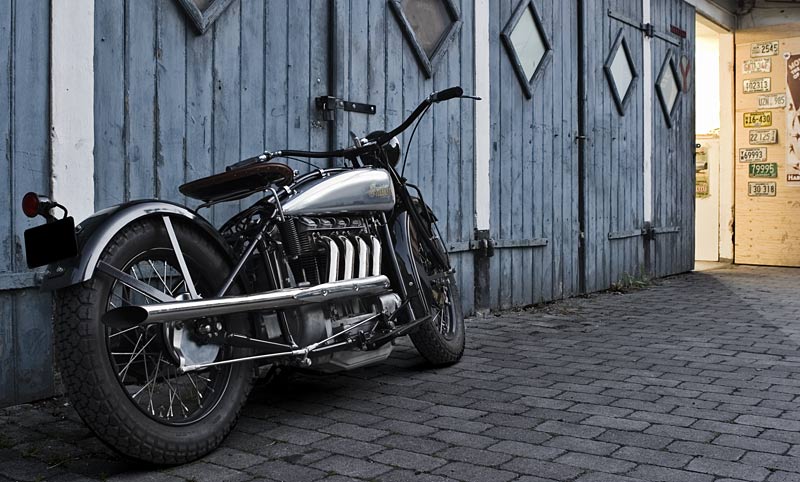 |
| Looking perfectly 'period', the Alma Four is a credit to its creator, Mads Bartholin |
The original Indian Four is a design icon, in its time among the most elegant motorcycles to grace the roads. Many attempts have been made to build a 'modern' copy, often using water-cooled car engines, but stylistically they're failures. Except one, which lives an ocean away from where the Indian, ACE and Henderson Fours were brought to life. Mads Bartholin always wanted an Indian Four, but like most of us, he couldn't afford one. Well-kept Fours go for about US$50-80K, and restoring a bad one will likely cost the same. ACE and Henderson Fours were just as out of reach, and acquiring something slightly less glamorous, like an Indian Scout, was not an option; Mads was firmly in the 'straight four' phase of his life.
 |
| An original ca.1928 Indian Four... |
Mads had already built one such four; a Danish Nimbus, which he rebuilt with an Indian Four style exhaust system, 16” rear wheel, Harley-Davidson solo seat, and a wide handlebar, and ridden it as far as to North Africa a few times. But much as he liked the Nimbus, he found its 22 bhp engine too weak. Realizing the futility of tuning the stock 750 cc engine, he decided to replace it with a 1000cc straight four from an NSU car. "The NSU engine is air cooled, inexpensive, looks kind of right and there are loads of them around”, claims Mads. The fast, brutal looking Münch Mammoth used just such an NSU Prinz TTS engine, with five times the power of the Nimbus. In 1997, he made moulds for a new Nimbus flywheel/clutch assembly housing to adapt to the NSU motor, plus a new sump to resemble the angular Nimbus original. A local foundry took care of this for a pittance, and after a few tries it looked right. Mads had suspected the car engine would be a bit on the large side for a Nimbus frame, which turned out to be the case. "It would fit – barely – but there simply wasn't any room for the gearbox or the gas tank", he notes, "so it was back to the drawing board".
 |
First it ran with an Amal carburettor, then with a leaky updraft Tillotson, and finally with this updraft Solex. Gearshift mechanism is from a Nimbus motorcycle, the generator from a VW. |
The project was redirected with the goal of creating a 1920s-style American Four. Many evenings and hours were spent at the basement workshop, where Mads would sit, beer in hand, carefully studying various 1:1 scale drawings hung up on the wall. Finally a version reminiscent of a 1928 Indian was decided upon. These first Indian Fours lack the comfort of rear suspension, and the elegance Art Deco fenders of the later Fours, and the upper frame backbone runs across the fuel tanks. The hybrid machine would be a couple of inches longer than its spiritual forefathers, because of the NSU's separate, longitudally mounted gearbox. Maintaining momentum on this project wasn't easy, mainly because Mads, while studying Industrial Design at The Royal Academy of Fine Arts, was perennially broke as a student. "Getting married and having two kids took its toll, too," says Mads, "although thankfully my wife – bless her - has given this project her full support all along the way". On the other hand, with only partial employment, and an uncanny ability to trade favors with people 'in the know', he was able to move forward. Slowly, the sorry remains of an Indian frame, as well as a good number of repro parts, were acquired. Like the frame lugs, both fenders, the solo seat, a complete leaf spring front end and the throttle assembly. Initially a BMW or Moto-Guzzi gearbox was considered, but Mads soon realized that because the NSU's engine rotation would give a lot of reverse gears! Eventually, a Nimbus gearbox with a new Swedish-built four speed gear cluster arrived at the workshop, along with its shaft drive and rear hub assembly. Somewhere on this journey the motorcycle acquired the name 'The Alma Four, 'Alma' being Latin for 'a particularly beautiful soul' [ah...hence Alma Mahler's legendary magnetism...pd'o].
 |
| The Alma Four is of necessity longer than the original Indian 4, to accomodate the longer engine, plus the gearbox and final driveshaft housing |
Old brochures and factory photographs usually show the Indian Four from the right hand side, where the elegant exhaust system makes the bike look fast even while parked. In contrast, the left side of Indian Four engines were a mess, cluttered up with the carburettor, the magneto and the dynamo. Paying homage to the original, this is the case with the Alma Four too, even if the distributor hides tidily at the back of the camshaft cover. The updraft Solex carburettor, more commonly found on Ferguson tractors or 1930s Citroën Traction Avants, is mated to a modified NSU intake manifold, and a belt drive spins a Bosch VW generator. In 2002, the engine came together, while a stainless steel four-into-one reverse cone exhaust system was built, mounted on shortened exhaust stacks. At the same time an aqcuaintance rebuilt the frame to match the one-off engine and shaft drive rear end. Many other members of the world-wide Indian motorcycle fraternity had been watching the Alma Four project from the sidelines, helping whenever possible and enthusiasticly cheering Mads on. One of them even flew in from the Fiji Islands to have a look.
 |
| An 'old school' conversion; a Nimbus shaft-drive engine installed in an Indian 4 chassis, some time ago... |
Once back from the welder, the frame was placed on the workbench and the engine dropped in. The twin fuel tanks had to be designed and built from scratch, because the ohc NSU engine was much taller than an original engine from Springfield. This was a bit of a problem, as Mads wanted to keep the bike low. Like the flywheel housing and engine sump, the fuel tanks were cast in aluminum. On the outside they appear stock, but underneath they're shaped to accommodate the large camchain housing, the overhead camshaft, and the valve covers. Plenty of work remained, of course; knurling the fuel caps, welding a bracket for the stock headlamp to resemble a cast item, even grinding the fender bolt heads to half their height were some of the dozens of jobs neccessary to make it all just right. The Indian designers back in the 1920s were damn good and Mads, now officially an industrial designer, was determined do at least as well.
 |
Twin cast-aluminum fuel tanks are hollowed out to accomodate the tall overhead camshaft engine, and the protruding valve covers |
In 2006, the Alma Four was finished; "The engine starts first kick, pulls strong, and the bike is steady like any other old 1920s large hardtail, at least up to the 100 mph I've taken it so far", according to Mads. Stopping the quarter-ton behemoth from high speed is a different matter, as the performance of the old Nimbus and Indian brake drums is limited. This NSU engine makes 40 bhp in its stock configuration, while the 1200cc version in the Münch Mammoth made more than 100bhp, and the final 1300cc NSU rally car versions made upwards of 300bhp, with oil-cooled cylinder heads and a turbocharger. "The engine is overengineered and the Alma Four weighs about one-quarter of the car it came from, so reliability is not an issue. Should something undesirable happen to it anyway, it's a fair guess that NSU parts will be cheaper than those for an Indian,” says Mads. "The front end is a repro Scout item, but a Chief version would have looked better, and a real paint job would have been nice too". But these are minor niggles. Unsurprisingly, even vintage bike purists give it a nod of approval, recognizing that no Indian parts were harmed to make this motorcycle. Was it worth spending all those hours building his Four, instead of working the same hours at a regular job, and simply buying an original Indian Four? "Definitely, if not for its value - which probably is on par with a 70-80 year old four anyway - then certainly for being able to ride a unique and comparatively much more reliable motorcycle”. The experience gained by designing and building a motorcycle almost from scratch, is priceless. It will come in handy for the ohv Super X hillclimber now on his workbench...


